
Place of Service Codes and Reimbursement Rate Changes: What Mental Health Therapists Need to Know
Heads up… If you bill insurance for telehealth, a 2-digit code on your claim form may be quietly affecting your paychecks!
A few months ago, I heard rumblings from therapists in the Midwest states that they had noticed sudden drops in their reimbursements rates. Recently, I heard the same reports from therapists in my North Carolina networking groups when they noticed their reimbursements drop noticeably. The pattern seems to be the same: Place of Service (POS) codes and a change in how some payers are now paying them.
This blog post explains:
what POS codes are,
why there is a rate difference,
the changes in payment, and
what you should check in your own practice.
I’m not a billing expert or attorney, this is simply general information rather than billing advice. You should follow your own payer contracts and consult a billing professional for your specific situation.
What is a Place of Service Code?
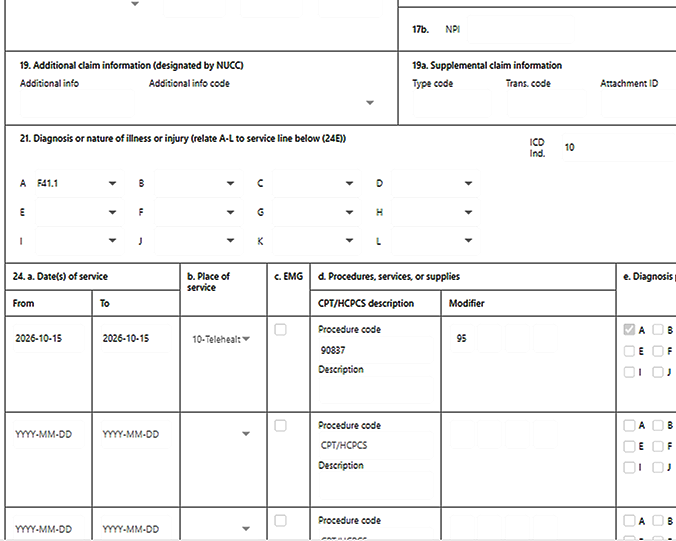
The POS code goes in Box 24B of the CMS-1500 claim form, and it tells the payer where the session took place. CMS (Centers for Medicare & Medicaid Services) defines and maintains the full list of these codes.
A few codes that private practice mental health clinicians, LPCs, LMFTs, LCSWs, LMHCs, LPs and others, are likely to use:
POS 11: Office- “location other than a hospital, skilled nursing facility, military treatment facility, community mental health center, state or local public health center, or intermediate care facility, where the health professional routinely provides health examinations, diagnosis, and treatment of illness or injury on an ambulatory basis.” Essentially, services provided in a private practice or office based setting.
POS 12: Home- “Location, other than a hospital or other facility, where the patient receives care in a private residence.”
For telehealth specifically, there are two relevant code as defined by CMS:
POS 10: Telehealth Provided in Patient’s Home– The location where health services and health related services are provided or received, through telecommunication technology. Patient is located in their home (which is a location other than a hospital or other facility where the patient receives care in a private residence) when receiving health services or health related services through telecommunication technology. (This code is effective January 1, 2022, and available to Medicare April 1, 2022.)
POS 02: Telehealth Provided Other than in Patient’s Home– The location where health services and health related services are provided or received, through telecommunication technology. Patient is not located in their home when receiving health services or health related services through telecommunication technology. (Effective January 1, 2017) (Description change effective January 1, 2022, and applicable for Medicare April 1, 2022.)

Why there are two codes, and why the rate differs
Before the 2020 pandemic, there was one way to bill telehealth- with POS 02. During the pandemic CMS relaxed its rules around telehealth to increase access to care. As telehealth grew, CMS added POS 10 and redefined POS 02 to only apply to when the patient wasn’t at home, since CMS realized that they needed to reimburse separate rates for facility and non-facility locations. In 2024, Medicare began reimbursing services with POS 02 at the lower facility rate and POS 10 at the higher non-facility rate. See this notice from NASW.
The reasoning in the difference in rates comes down to overhead. When a client receives care at a facility, such as a hospital or skilled nursing facility, the facility bills its own separate codes to the payer, effectively covering the cost of the building, the staff, and the equipment. Because that overhead is covered elsewhere, the professional service itself is paid less.
When a client is in their own home (or home setting such as their car, office, their friend’s home), there is no facility billing those additional overhead codes. A solo or group private practice isn’t billing any “facility” fees, so the cost of running the practice is wrapped into the single code billed for the session. That is why non-facility POS 10 telehealth pays more than facility POS 02 telehealth.
How this might affect you
Like I mentioned, in 2024, CMS began paying POS 02 at the lower facility rate and POS 10 at the non-facility rate. Commercial payers normally follow what CMS does, but on a different timeline… usually much slower! It seems that BCBS payers in the Midwest began paying out at 02 at facility rates and 10 at non-facility rates earlier this year, while BCBS of NC made the change starting 10/1/2026. BCBS of NC announced in August 2026 that this change would be taking effect October 1st, but many therapists missed the memo.
If you’ve been billing POS 02 out of habit without realizing the description and the payment rates changed, you may now be paid less than you were previously, not because your contract changed, but because the payers finally enacted the change.
Which Code should you use?
Let’s be real, the CMS publications themselves are not easy to understand and seem to be written to be purposefully confusing… for example, their definitions of “home” and “private residence” could use a whole lot more clarification!
Looking at the bigger picture of the function of the codes and facility/ non-facility rates does bring some clarity, but there is so much need for more clarification, especially from commercial payers. CMS’s own language limits POS 10 to a “private residence” but guidance from at least one Medicare Administrative Contractor defines it more broadly to include their car or work, since they are “not in a hospital or other facility” when receiving care.
Mental health billing experts that I have spoken with about the telehealth POS definitions have defined “private residence” as a location that is private to the client and not in a facility. But the guidance from commercial payers as to the definition of “home” and “private residence” is generally vague or lacking.
If you’re providing office based mental health services from a solo or group private practice, you are very likely not a facility… and if you are, you probably know that you are!
What to do this week
Check your contracts and provider manuals for POS guidance specific to telehealth. And may the odds be ever in your favor if you have to call the payer and request guidance.
Compare recent telehealth remittances to what you expected, especially for sessions billed as POS 02.
Read payer bulletins and newsletters, even the ones you’d normally skim past.
Check your EHR or clearinghouse billing settings and update your default POS code if needed.
Call the payer’s provider line if something doesn't match your contract, before assuming the new rate is correct.
A related but separate issue: down-coding
Separately from the POS rate change, some practices have reported “down-coding,” where a payers automated system changes a submitted code to a lower-paying one without clear notice, for example, billing 90837 and receiving the EOB back with the code changed to 90834 and that payment amount. This seems to be happening more to prescribers billing E/M codes for medication management. I have heard chatter about this, but have yet to confirm if the mental health therapists/non-prescribers are experiencing true “down-coding”, the POS 02/10 issue, or a separate payment/contracting issue. It’s worth knowing that some payers are engaging in down-coding which results in increased administrative time appealing the changes so keep an eye out for this as well.
I hope you found this helpful and that the new information was enlightening. I do wish the answers were cut and dry… but unfortunately the US health insurance system doesn’t value Making Sense as much as I do!
I’m not a billing expert or attorney. This is general information, not billing advice. Always follow your payer contracts and guidance, and consult a qualified billing professional for your specific situation.
I would love to hear your thoughts and what your experiences with billing these POS codes has been. And if you receive guidance from payers or billing experts, please let me know so I can share with the community. You can also join the FB community Private Practice Cents and share your experiences there!
Want help making sure your own settings are right?
Book a 1:1 consult and I’ll walk you through configuring your EHR, payer, and claim settings for smoother processing.
Office hours are coming soon!! I’m launching a monthly group video call to talk through news like this and troubleshoot issues together. Look out for an email announcement with more information on how to join!
Sources:
List of POS codes https://www.cms.gov/medicare/coding-billing/place-of-service-codes/code-sets
MAC guidance regarding POS 10 can include car and work: https://provider.wellpointfederal.com/web/provider/news-article-details?selectedArticleId=10638446&lob=96664&state=97133&rgion=93623
CMS Final Rule: https://www.cms.gov/medicare/medicare-fee-service-payment/physicianfeesched/pfs-federal-regulation-notices/cms-1784-f
CMS MLN announcement: https://www.cms.gov/files/document/mm12427-newmodifications-place-service-pos-codes-telehealth.pdf
Barbara Griswold Mental Health Insurance Guide https://theinsurancemaze.com/medicareclarifications/
BCBS of NC August 2026 announcement: https://www.bcbsnc.com/providers/provider-news/2026/reimbursement-policy-update-telehealth-place-of-service-02-reimbursement
© 2026 Private Practice Cents. All rights reserved. This blog post is for informational purposes only, it is not legal, tax, accounting, clinical or insurance advice. No consultant-client relationship is created between you and Amy Neal or Private Practice Cent